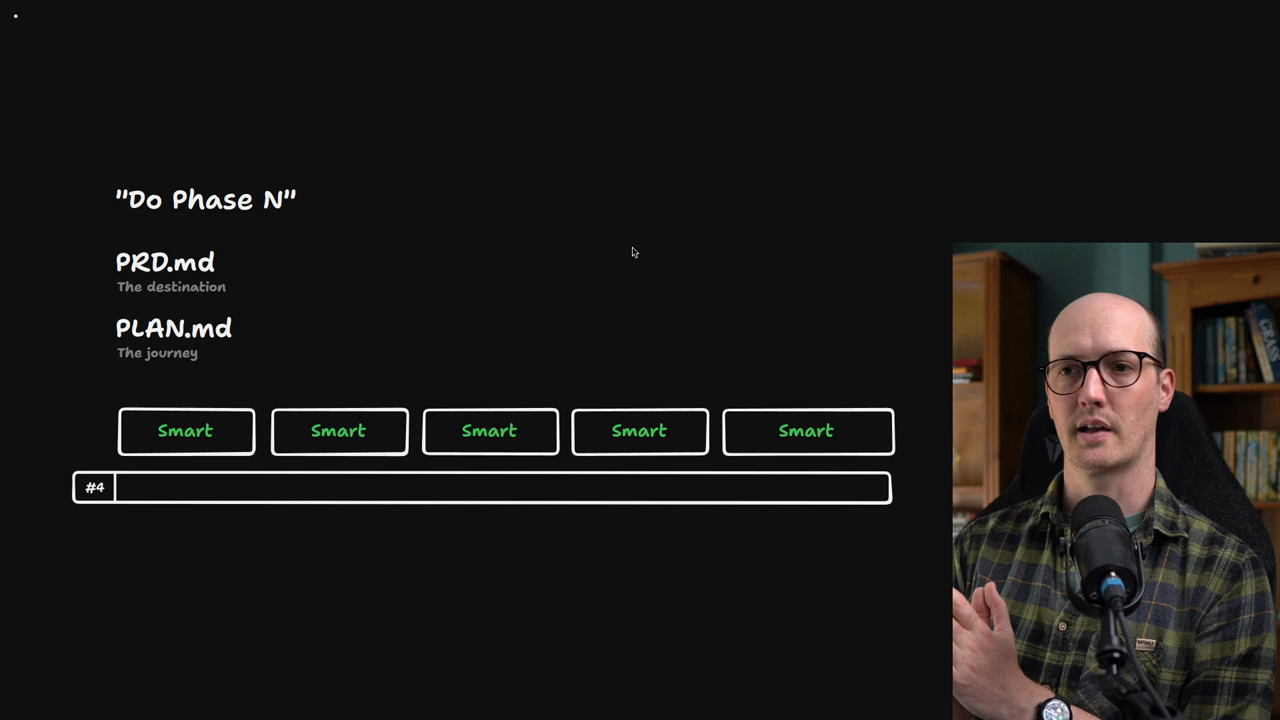
Let me take you back to the mental model we built around multi-phase plans. The core idea is to break down large chunks of work so agents can process them within their optimal operating zone.
This approach requires three key inputs:
<TableWrapper>
| Input | Purpose |
|---|---|
| Destination | Where you're trying to get to |
| PRD | The product requirements document |
| Plan | The journey the agent will take |
| Instruction | Which phase to execute (phase one, two, three, etc.) |
| </TableWrapper> |
There's a significant issue with this setup. The "Do Phase N" command means a human needs to sit with the agent, manually telling it which phase to execute next. This feels wasteful.
The entire flow requires a human in the loop, or HITL as it's known. But this can be automated.
"Do Phase N" is essentially a for loop waiting to be automated. Everything inside that loop is already set up for automation.
If you've been monitoring agents while building plans, you might have noticed something: I don't really need to be here at all.
Your destination is mapped out. The journey for the agent is defined. You could just wait at the end and review whatever comes out.
The "Do Phase N" step can absolutely be handled by a for loop.
I felt this way for a long time while using agents through December 2025. But something shifted that month. The models became good enough that you could send them off to execute these well-defined tasks and they would do excellent work.
Geoffrey Huntley's article really put me onto this. He talks about using a simple for loop to run a prompt over and over again to complete tranches of work.
That's when the approach clicked. You could delegate massive amounts of work to agents while you handle other things like planning future work or quality assuring other agent runs.